Introduction
Every competitive gamer faces the same question? what sensitivity should I use? DPI vs Sensitivity vs eDPI, tweak your in-game sensitivity, and still your aim feels off. Headshots slip past your crosshair. Flicks overshoot their target. Your mouse feels either too slow or impossibly fast.
The problem is not your skill. The problem is that DPI, sensitivity, and eDPI all work together, and changing one without understanding the others leaves you guessing. This guide breaks down exactly what each setting does, how they interact, and how to find the perfect combination for your playstyle.
What is DPI?
DPI stands for Dots Per Inch. It measures how sensitive your mouse is at the hardware level. When you move your mouse one physical inch across your mousepad, your mouse sensor counts that movement in dots. A mouse set to 800 DPI registers 800 dots of movement per inch. A mouse set to 1600 DPI registers 1,600 dots.
Higher DPI makes your cursor travel farther on screen for the same physical movement. Lower DPI requires more hand movement to cover the same screen distance. DPI is a hardware setting controlled either by buttons on your mouse or through manufacturer software like Logitech G HUB, Razer Synapse, or Corsair iCUE.
Most gaming mice support DPI ranges from 400 to 8000 or higher. The number alone does not tell you whether your sensitivity is high or low it only tells you how precisely your mouse sensor tracks movement.
What is In-Game Sensitivity?
In-game sensitivity is a software multiplier that controls how far your crosshair moves in response to mouse input. Every game has its own sensitivity scale. A sensitivity of “1.0” in Valorant does not equal “1.0” in CS2 or Apex Legends. Games measure sensitivity differently, which makes direct comparisons impossible without a conversion formula.
Unlike DPI, which applies system-wide, in-game sensitivity only affects the game where you set it. You can run 800 DPI on your desktop, then use different sensitivity values in Valorant, CS2, and Fortnite all at the same time.
Higher in-game sensitivity makes your crosshair move faster. Lower in-game sensitivity slows it down and requires more physical mouse movement to turn or track targets.
What is eDPI?
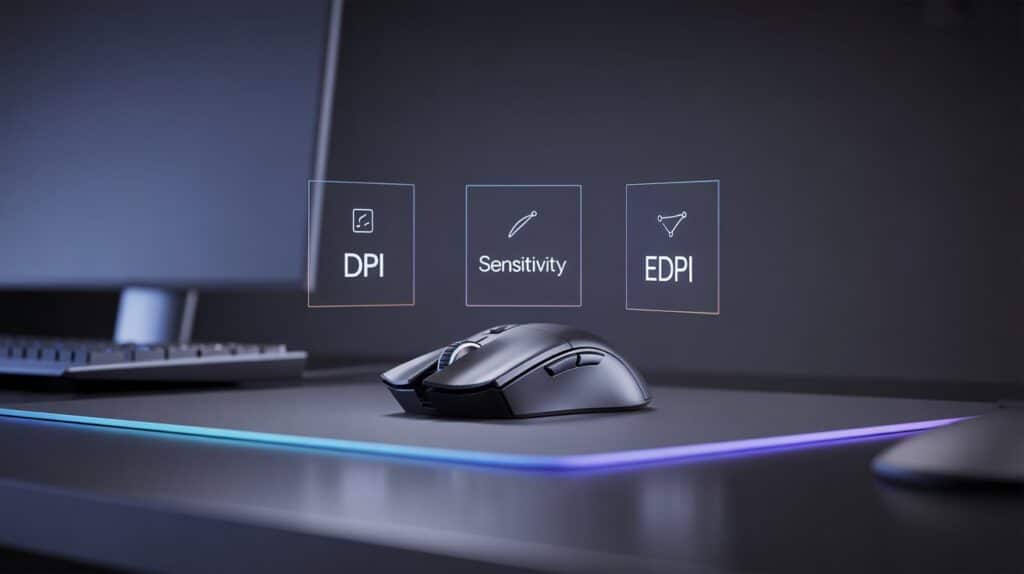
eDPI stands for Effective Dots Per Inch. It combines your mouse DPI and your in-game sensitivity into one number that reveals your actual sensitivity during gameplay. This is the measurement that actually matters.
The formula is simple:
eDPI = DPI × In-Game Sensitivity
Two players can have wildly different DPI and sensitivity settings but identical eDPI — which means their actual aim speed is the same.
Example 1: Four players with the same eDPI
| Player | DPI | Sensitivity | eDPI | Result |
|---|---|---|---|---|
| Player A | 400 | 2.0 | 800 | Same aim speed |
| Player B | 800 | 1.0 | 800 | Same aim speed |
| Player C | 1600 | 0.5 | 800 | Same aim speed |
| Player D | 3200 | 0.25 | 800 | Same aim speed |
All four players turn their crosshair at the exact same speed even though their individual settings look completely different. This is why eDPI is the only accurate way to compare sensitivity between players.
Example 2: Same sensitivity, different DPI
| Player | DPI | Sensitivity | eDPI | Result |
|---|---|---|---|---|
| Player A | 400 | 2.0 | 800 | Slow aim |
| Player B | 800 | 2.0 | 1600 | Medium aim |
| Player C | 1600 | 2.0 | 3200 | Fast aim |
| Player D | 3200 | 2.0 | 6400 | Very fast aim |
Even though all four players use the same in-game sensitivity (2.0), their actual aim speed doubles with each DPI increase. Looking at sensitivity alone without DPI gives you zero useful information.
DPI vs Sensitivity vs eDPI — What’s the Difference?
These three settings control different parts of your mouse behavior:
| Setting | What It Controls | Where You Change It | What It Affects |
|---|---|---|---|
| DPI | Hardware sensitivity | Mouse software or buttons | System-wide cursor speed |
| Sensitivity | Software multiplier | In-game settings menu | That specific game only |
| eDPI | True effective sensitivity | Calculated (DPI × Sens) | Your actual aim speed |
- DPI sets the foundation. Your mouse sensor physically tracks this many dots per inch of movement.
- Sensitivity multiplies that foundation. The game takes your DPI input and scales it by your sensitivity value.
- eDPI reveals the final result. It tells you how fast your crosshair actually moves when you combine both settings.
- You cannot compare two players’ aim speed by looking at DPI alone or sensitivity alone. You must calculate their eDPI to see who actually aims faster.
Why 800-1600 DPI is the Sweet Spot
Walk into any esports tournament and you will find that 90% of professional FPS players run DPI between 400 and 1600. The vast majority cluster around 800 DPI. This is not random preference it is the result of technical limitations and practical testing.
The Technical Reasons
Modern optical sensors perform best between 400-1600 DPI. Mouse manufacturers optimize their sensors for this range. Going higher introduces potential issues:
- Smoothing and interpolation — Some sensors apply smoothing at very high DPI settings (above 3200), which adds a tiny input delay that competitive players can feel.
- Jitter and instability — Ultra-high DPI settings (6400+) can cause micro-jitter even when your hand stays perfectly still.
- CPU overhead — Higher DPI combined with high polling rates (1000 Hz+) increases CPU load, which can hurt performance on mid-tier systems.
Lower DPI settings (400 or below) create pixel skipping problems. When your DPI drops too low, small hand movements do not register any cursor movement at all. Your crosshair stays frozen until you move far enough for the sensor to detect a full dot of movement then it jumps multiple pixels at once. This ruins precision aiming.
The Practical Reasons
Desktop usability matters. A mouse locked at 400 DPI crawls across your screen during normal computer use. You need to swipe your entire arm just to move from one monitor edge to the other. 800-1600 DPI keeps your desktop cursor at a comfortable speed while still allowing low eDPI values in-game through sensitivity adjustment.
Consistency across setups. Most gaming mice ship with 800 DPI as their default setting. Sticking with this standard makes it easier to match your sensitivity when switching mice or playing on different systems.
How to Calculate Your eDPI
The formula is identical across all games:
eDPI = DPI × In-Game Sensitivity
Valorant Example
- DPI: 800
- Sensitivity: 0.4
- eDPI: 800 × 0.4 = 320
CS2 Example
- DPI: 400
- Sensitivity: 2.5
- eDPI: 400 × 2.5 = 1000
Apex Legends Example
- DPI: 1600
- Sensitivity: 1.8
- eDPI: 1600 × 1.8 = 2880
You can verify your calculation using our free eDPI calculator, which also shows you how your eDPI compares against professional players in your game.
How to Find Your Perfect eDPI (Step-by-Step Method)
Finding your ideal eDPI takes testing, not guessing. Follow this exact process:
Step 1: Pick a Starting DPI
Set your mouse to 800 DPI. This is the most common setting among pros and provides the best balance between desktop usability and in-game precision.
Use our mouse DPI analyzer to confirm your actual DPI if you are not sure what your mouse is currently set to.
Step 2: Measure Your Mousepad Space
Place a ruler or measuring tape on your mousepad. Measure how many centimeters of space you have from your mouse’s resting position to the edge of your pad in both directions. Most standard gaming mousepads give you 30-40 cm of horizontal space.
Step 3: Test the 360-Degree Turn Method
Load into a practice range or empty map in your main game. Stand still and look straight ahead. Move your mouse from the center of your pad to the edge in one smooth motion. Your character should turn exactly 360 degrees and face forward again.
If your character turns less than 360 degrees, your sensitivity is too low. Increase it.
If your character turns more than 360 degrees, your sensitivity is too high. Decrease it.
Adjust in small increments (0.05-0.1 sensitivity) until you hit exactly 360 degrees with one full mousepad swipe.
Step 4: Calculate Your cm/360
The physical distance you just measured is your cm/360 the number of centimeters your mouse must travel to turn 360 degrees in-game. Most competitive FPS players land between 25-35 cm/360. Lower numbers mean faster sensitivity. Higher numbers mean slower sensitivity.
Step 5: Fine-Tune with Actual Gameplay
Your 360-degree test gives you a baseline, but real gameplay tells you whether that sensitivity actually works. Jump into deathmatch or casual matches and pay attention to these specific scenarios:
Tracking moving targets — Can you follow an enemy strafing left and right without overshooting or falling behind?
Flick shots — Can you snap your crosshair to a target’s head in one motion without overshooting?
Holding angles — Can you keep your crosshair perfectly still on a corner or doorway without micro-jitter?
If you consistently overshoot, lower your sensitivity by 0.05-0.1. If you feel sluggish and cannot turn fast enough, raise it by the same increment. Make changes slowly. Your muscle memory needs time to adapt.
Step 6: Lock It In and Build Muscle Memory
Once you find a sensitivity that feels smooth for tracking, crisp for flicks, and stable for holding angles, stop changing it. Write down your exact DPI and sensitivity. Never adjust them again unless you switch games or make a major hardware change.
Consistency builds muscle memory. Constantly tweaking your sensitivity resets your progress and keeps your aim permanently inconsistent.
eDPI Benchmarks by Game
Different games require different aim styles, which is why pro players use different eDPI ranges depending on the title. Here are the competitive standards:
Valorant
- Low eDPI: 200-280 (precise, tactical gameplay)
- Medium eDPI: 280-400 (most common among pros)
- High eDPI: 400-550 (fast flicks, aggressive playstyle)
- Pro average: ~280 eDPI
Popular pro settings:
- TenZ: 800 DPI × 0.35 sens = 280 eDPI
- Aspas: 800 DPI × 0.336 sens = 269 eDPI
CS2
- Low eDPI: 600-800 (maximum precision)
- Medium eDPI: 800-1200 (most popular range)
- High eDPI: 1200-1600 (entry fraggers, aggressive AWPers)
- Pro average: ~880 eDPI
Popular pro settings:
- s1mple: 400 DPI × 3.09 sens = 1236 eDPI
- ZywOo: 400 DPI × 2.0 sens = 800 eDPI
Apex Legends
- Low eDPI: 800-1200 (precise tracking for beam weapons)
- Medium eDPI: 1200-2000 (balanced movement and aim)
- High eDPI: 2000-3200 (fast movements, close-range fights)
- Pro average: ~1600 eDPI
Popular pro settings:
- ImperialHal: 800 DPI × 1.8 sens = 1440 eDPI
- Verhulst: 800 DPI × 2.0 sens = 1600 eDPI
Fortnite
- Low eDPI: 3000-5000 (build accuracy, shotgun flicks)
- Medium eDPI: 5000-8000 (most common among builders)
- High eDPI: 8000-12000 (fast edits, quick 180s)
- Pro average: ~6000 eDPI
Fortnite runs significantly higher eDPI than tactical shooters because building mechanics require fast 180-degree turns and rapid camera movements.
Use these benchmarks as starting points, not strict rules. Your ideal eDPI depends on your mousepad size, arm length, and playstyle.
cm/360: The Physical Measurement That Matters
eDPI tells you your sensitivity numerically. cm/360 tells you your sensitivity physically — how many centimeters you must move your mouse to turn 360 degrees in-game.
Two players with identical eDPI in different games will have different cm/360 values because each game handles mouse input differently. This is why serious players track cm/360 instead of relying on eDPI alone when switching between titles.
Typical cm/360 Ranges by Playstyle
| cm/360 Range | Playstyle | Best For |
|---|---|---|
| 15-25 cm | Very high sensitivity | Close-range aggression, fast flicks |
| 25-35 cm | Medium-high sensitivity | Balanced gameplay, entry fragging |
| 35-50 cm | Medium-low sensitivity | Precision tracking, holding angles |
| 50-70 cm | Low sensitivity | Maximum precision, AWP/sniper play |
| 70+ cm | Very low sensitivity | Extreme arm-aiming setups |
Most competitive FPS players fall between 25-40 cm/360. This range forces you to use your entire arm for large turns while reserving wrist movements for micro-adjustments and precision aiming.
DPI vs Sensitivity: Which Should You Adjust?
When you want to change your overall sensitivity, should you adjust DPI or in-game sensitivity? The answer depends on what you are trying to fix.
Adjust In-Game Sensitivity When:
- You want different sensitivity in different games
- You need fine-tuned control (0.01 increments)
- Your DPI is already at an optimal level (800-1600)
- You are matching a specific eDPI target
Adjust DPI When:
- Your desktop cursor feels too fast or too slow
- You are experiencing pixel skipping (DPI too low)
- Your aim feels jittery or smoothed (DPI too high)
- You want to match hardware across multiple mice
The Best Practice:
Set your DPI once to an optimal value (800 or 1600) and leave it there permanently. Adjust all sensitivity changes through in-game settings. This keeps your muscle memory consistent across your entire system and makes troubleshooting easier when something feels off.
High DPI + Low Sensitivity vs Low DPI + High Sensitivity
Two players can reach the same eDPI through opposite paths: high DPI with low in-game sensitivity, or low DPI with high in-game sensitivity. Does the path matter?
Yes. Modern testing shows measurable differences.
High DPI (800-1600) + Low Sensitivity
Advantages:
- Smoother pixel-to-pixel cursor movement
- Less pixel skipping during small adjustments
- Slightly lower input latency (measurable but barely perceptible)
- Better tracking during slow, controlled movements
Disadvantages:
- Faster desktop cursor (some users find this uncomfortable)
- Higher CPU load (negligible on modern systems)
Low DPI (400) + High Sensitivity
Advantages:
- Slower, more controlled desktop cursor
- Traditional setup many older pros grew comfortable with
- Lower system resource usage
Disadvantages:
- Potential pixel skipping during micro-adjustments
- Less smooth movement at very slow tracking speeds
- Cursor feels “jumpier” when making tiny movements
The Current Standard: Modern competitive gaming favors 800-1600 DPI with proportionally lower in-game sensitivity. This provides smoother pixel transitions and eliminates pixel skipping without creating an uncomfortably fast desktop cursor. Most new pros choose 800 DPI. Some prefer 1600 DPI for even smoother tracking.
How Polling Rate Affects Your Sensitivity
Polling rate measures how many times per second your mouse reports its position to your computer. A mouse running at 1000 Hz sends 1,000 position updates every second.
Polling rate does not change your eDPI or your sensitivity values. It changes how smoothly your crosshair moves between positions. Higher polling rate creates smoother, more responsive cursor movement. Lower polling rate makes your crosshair feel delayed and choppy.
Polling Rate Impact on Gameplay
| Polling Rate | Update Delay | Effect on Aim |
|---|---|---|
| 125 Hz | 8 ms | Noticeable lag, choppy tracking |
| 500 Hz | 2 ms | Smooth for casual play |
| 1000 Hz | 1 ms | Esports standard, instant response |
| 2000-8000 Hz | 0.5-0.125 ms | Marginal improvement, high CPU cost |
Most competitive players run 1000 Hz polling rate. This delivers near-instant response without taxing your CPU. Going higher offers minimal benefit and can cause performance issues on mid-tier systems.
Verify your actual polling rate using our mouse polling rate tester to make sure your mouse is actually running at the speed you set in its software.
Mouse Acceleration: Why It Ruins Your Aim
Mouse acceleration changes your cursor speed based on how fast you move your mouse. Move slowly and your cursor crawls. Move quickly and your cursor flies.
This sounds useful in theory. In practice, it destroys consistency. The same physical hand movement produces different on-screen results depending on your movement speed. Your muscle memory cannot adapt because the relationship between input and output keeps changing.
How to Disable Mouse Acceleration
Windows 10/11:
- Open Settings → Devices → Mouse
- Click “Additional mouse options”
- Select the “Pointer Options” tab
- Uncheck “Enhance pointer precision”
- Click Apply
Check your game settings too. Some games include their own built-in mouse acceleration toggle buried in advanced settings. Search for terms like “mouse smoothing,” “mouse acceleration,” or “raw input.” Enable raw input if available it bypasses Windows processing entirely and feeds mouse data directly to the game.
Test your setup using our reaction time test after disabling acceleration. You should feel noticeably more control over small cursor movements.
Common Sensitivity Problems and How to Fix Them
Problem 1: Your Crosshair Overshoots Every Target
Cause: Your eDPI is too high for your mousepad space and hand control.
Fix: Lower your in-game sensitivity by 0.1 and test again. Repeat until flick shots land consistently on target without overshooting. Most players need to drop their sensitivity significantly when they first start optimizing.
Problem 2: You Cannot Turn Fast Enough
Cause: Your eDPI is too low, or your mousepad is too small.
Fix: Either increase your sensitivity by 0.1 or upgrade to a larger mousepad (at least 45cm width). Competitive players need space to make large arm movements.
Problem 3: Your Aim Feels Jittery Even When Your Hand is Still
Cause: DPI is set too high (3200+), causing sensor jitter, or your mouse has a low-quality sensor.
Fix: Lower your DPI to 800 and increase in-game sensitivity to maintain the same eDPI. If jitter persists, your mouse sensor may be failing or your surface may be incompatible. Test on a proper mousepad.
Problem 4: Small Movements Do Not Register
Cause: DPI is too low (400 or below), causing pixel skipping.
Fix: Increase DPI to 800 and lower in-game sensitivity proportionally. Modern sensors perform better at higher DPI settings within the 800-1600 range.
Problem 5: Your Sensitivity Feels Different on Different Days
Cause: You are changing settings too frequently. Your muscle memory never stabilizes.
Fix: Pick one eDPI and lock it in for at least 30 days. Write it down. No adjustments allowed. Your aim will feel inconsistent for the first week as your muscle memory adapts, then it will stabilize and improve.
How to Convert Between Different DPI Settings
When you upgrade your mouse or want to try a different DPI, you need to maintain the same eDPI to keep your aim feeling identical.
The Conversion Formula
New Sensitivity = Current eDPI ÷ New DPI
Example: Converting from 400 DPI to 800 DPI
Current settings:
- DPI: 400
- Sensitivity: 2.5
- eDPI: 400 × 2.5 = 1000
New settings to maintain same eDPI:
- DPI: 800
- New Sensitivity: 1000 ÷ 800 = 1.25
- eDPI: 800 × 1.25 = 1000 ✓
Example: Converting from 1600 DPI to 800 DPI
Current settings:
- DPI: 1600
- Sensitivity: 0.5
- eDPI: 1600 × 0.5 = 800
New settings to maintain same eDPI:
- DPI: 800
- New Sensitivity: 800 ÷ 800 = 1.0
- eDPI: 800 × 1.0 = 800 ✓
Use our eDPI calculator to verify your conversion math and ensure your new settings match your old eDPI exactly.
Frequently Asked Questions
What is the best eDPI for beginners?
Start with 800 DPI and adjust in-game sensitivity until one full mousepad swipe turns you 360 degrees. For most players, this lands around 800-1200 eDPI in tactical shooters like Valorant or CS2. This range provides good precision without feeling sluggish. Once you build muscle memory over 2-4 weeks, fine-tune based on whether you overshoot or undershoot targets.
Should I use the same eDPI across all games?
No. Different games require different aim styles. Valorant rewards slow, precise crosshair placement (low eDPI). Apex Legends demands fast tracking and quick turns (higher eDPI). Fortnite needs rapid 180s for building (very high eDPI). Use similar cm/360 measurements across games instead this keeps the physical feel consistent even though eDPI numbers differ.
Why do pros use such low sensitivity?
Professional players prioritize consistency over speed. Lower eDPI forces you to use your entire arm for aiming, which provides steadier muscle control than wrist-only movements. Arm aiming eliminates micro-jitter and makes tracking smoother. Most pros run between 25-40 cm/360, which requires large arm movements but delivers tournament-level precision.
Does higher DPI improve aim?
Within the 800-1600 range, yes higher DPI provides smoother pixel-to-pixel movement and eliminates pixel skipping. Beyond 1600 DPI, benefits drop off sharply. Most sensors introduce smoothing or jitter above 3200 DPI, which actually hurts aim. The sweet spot is 800-1600 DPI paired with low in-game sensitivity to achieve your target eDPI.
What is the formula for calculating eDPI?
eDPI = DPI × In-Game Sensitivity. For example, 800 DPI with 0.5 sensitivity equals 400 eDPI. This formula works identically across all games, but remember that the same eDPI number means different things in different titles because games handle mouse input differently.
How do I know if my eDPI is too high?
Your eDPI is too high if you consistently overshoot targets during flick shots, your crosshair feels twitchy when holding angles, or you cannot make small adjustments without moving multiple pixels. Lower your sensitivity by 10% and test for one week. If your aim stabilizes, keep reducing until you find your limit.
Can I use different DPI for different games?
You can, but you should not. Changing DPI between games forces your muscle memory to relearn desktop cursor speed every time you switch titles. Set your DPI once (800 or 1600) and adjust only in-game sensitivity. This keeps your system-wide muscle memory consistent and makes troubleshooting easier.
What is cm/360 and why does it matter?
cm/360 measures how many centimeters you must physically move your mouse to turn 360 degrees in-game. It translates eDPI into real-world mousepad distance. Two games with the same eDPI can have different cm/360 values because they process mouse input differently. Serious players track cm/360 to maintain consistent physical feel across multiple titles.
How long does it take to get used to a new sensitivity?
Full muscle memory adaptation takes 20-30 hours of focused gameplay. The first week feels awkward. Your brain is relearning the relationship between hand movement and crosshair position. After two weeks, the new sensitivity starts feeling natural. After a month, it becomes automatic. Never change sensitivity during this adaptation period you will reset your progress.
Should I disable mouse acceleration?
Yes, always. Mouse acceleration makes your cursor speed unpredictable by varying it based on how fast you move your mouse. Competitive gaming requires absolute consistency the same hand movement must produce the same crosshair movement every single time. Disable “Enhance pointer precision” in Windows and check for in-game acceleration settings. Enable “raw input” in your game if available.
Related Tools:
- Mouse DPI Analyzer — Check your actual mouse DPI
- eDPI Calculator — Calculate and compare eDPI across games
- Mouse Polling Rate Test — Verify your mouse reports at the correct Hz
- Reaction Time Test — Measure how fast you react after changing sensitivity

PollingRateTester.com provides browser-based testing tools for measuring mouse DPI, polling rate, latency, and other device performance metrics. All tools are tested on real hardware, including USB and Bluetooth mice and high-refresh-rate monitors, to ensure accurate and repeatable results.
The website is maintained by a technical team that regularly updates tools and guides in response to browser, sensor, or firmware changes to keep measurements consistent, precise, and transparent.